17
Jan
The flowers of the forget-me-not are edible. The flowers bloom in spring summer and fall.

Fun facts about forget me not flowers. Facts About Forget-Me-Not Flowers You Should Know. April 24 2021 by Shiny Aura. There is a flower called forget-me-not flower.
It has a Latin name Myosotis. On tall hairy stems this flower grows. Sometimes this plant can also grow up to two-feet tall.
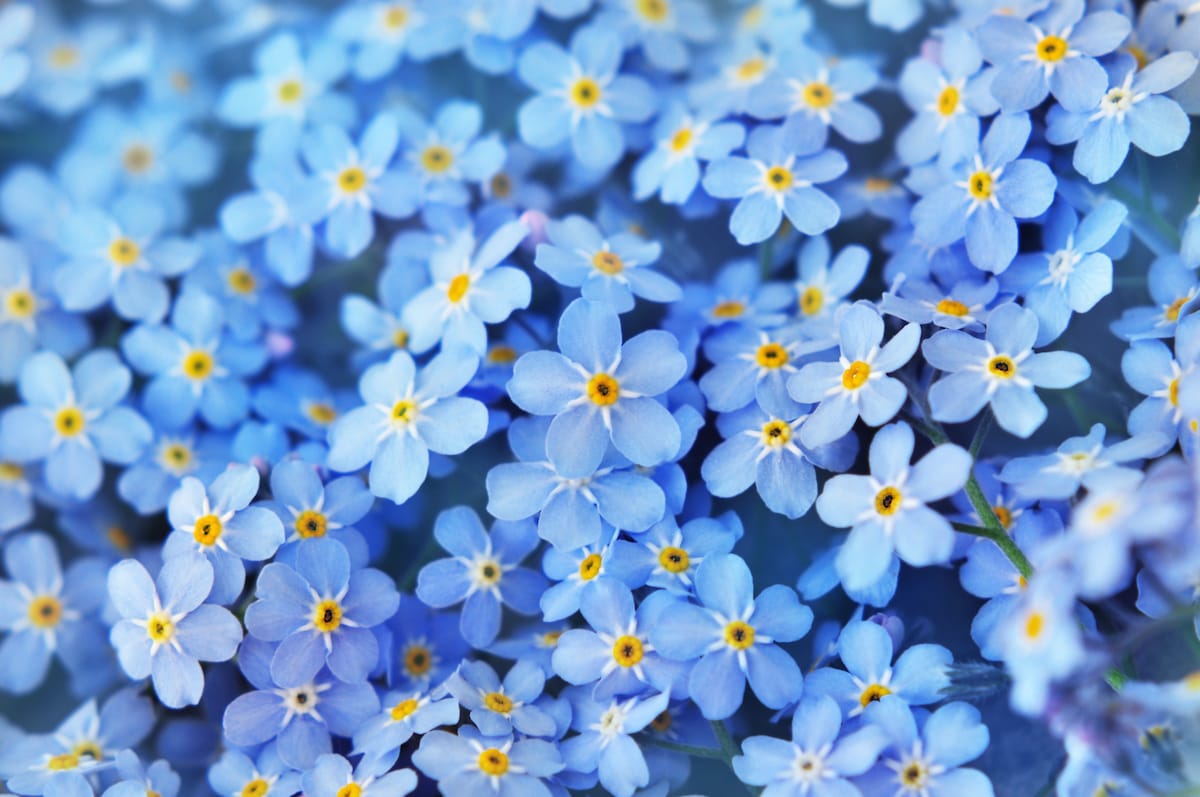
In general it has five charming blue petals with the yellow center. Known scientifically as myosotis forget-me-nots are plants with clusters of dainty little flowers about 1 cm in diameter. There are about 50 different species.
These popular spring time flowers are commonly blue with yellow centers but white and pink varieties are also available. Leaves are grey-green hairy and stalkless. True forget-me-not Myosotis scorpioides reaches about 1 foot tall and wide and grows in USDA zones 5 through 9.
It prefers moist soil and begins blooming in early summer. Forget-me-not Facts Forget-me-not is herbaceous plant that belongs to the cynoglossum family. There are less than 100 species of forget-me-not most of which originate from temperate parts of northern hemisphere.
Forget-me-not grows on the moist soil exposed to direct sunlight or in the partial shade. In general forget me not flower meaning is remembrance and love. During the middle ages lovers in Germany were wearing forget-me-nots as a reminder of their love for each other.
But forget me not flower meaning can also be negative. Until this day it is a symbol of freemasons who suffered during WWII. Facts about forget-me-not Forget-me-nots flower in spring.
A large number of species that come under the forget-me-not category are native to New Zealand. A few European Species were introduced in the temperate regions of America Asia and Europe. Forget-me-not is the state flower.
Forget-me-not is a well-known flowering plant in the borage family Boraginaceae making it a relative of such herbs and landscape plants as borage Borago officinalis variegated Siberian bugloss Brunnera macrophylla Jack Frost and Italian bugloss Anchusa azurea. True forget-me-not grows best in wet places including moist woodlands and streamsides. True forget-me-not has a unique flower arrangement in which flower buds are positioned along the length of tightly coiled stems.
These stems unfurl as the flowers bloom forming an elongated cluster. Forget-me-nots were Princess Dianas favorite flowers and are included in a memorial garden dedicated to her at her former residence Londons Kensington Palace. There are 3500 white forget-me-nots planted in her honor in the garden.
The flowers of the forget-me-not are edible. You can eat them raw in a trail mix or salad or use them as a garnish or cake decoration notes Edible Wild Food. You can also make candied.
The most widely grown garden forget-me-not it stands between 5 inches and 1 foot high with oblong to tapering downy green foliage. Its dense curling spikes of white-or yellow-centered five-lobed flowers unfurl in early to mid-spring. Woodland forget-me-nots numerous cultivars include the.
Myosotis is a genus of flowering plants in the family Boraginaceae that are commonly called Forget-me-nots. Similar names and variations are found in many different languages. Similar names and variations are found in many different languages.
A forget-me-nots tiny flowers have five petals and a yellow eye in the center. The petals of most forget-me-nots change from pink to blue as the plant grows. The flowers bloom in spring summer and fall.
Before the flowers appear the plants coiled stem looks like a scorpions tail. The Forget me not flowers have a white inner ring and a yellow center. Forget me not produces bright clear blue flowers.
The best time to see the Forget me not is midsummer from late June to late July. Facts About Forget me not. Forget me not plant is tiny with elliptical and hairy leaves in a rosette at the bottom and about 2 cm long.
Perennial forget-me-nots are much harder to find and most Alaskans have never seen them thinking the much more commonly available Myosotis sylvatica is. The small blue forget-me-not flower was first used by the Grand Lodge Zur Sonne in 1926 as a Masonic emblem at the annual convention in Bremen Germany.
Previous post
Fun facts about kiss me kateNext post
Fun facts about cant buy me love